
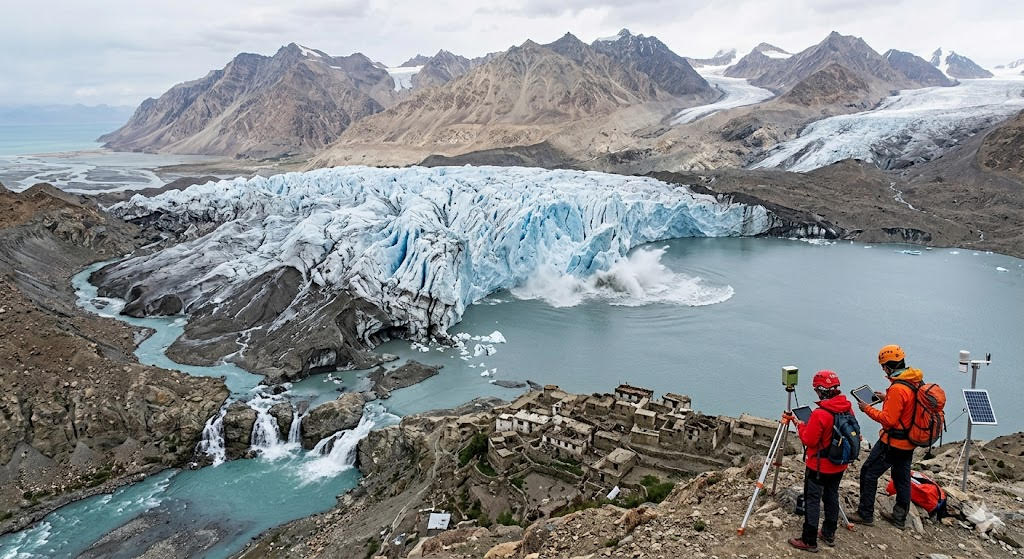

New data reveals that glaciers outside the poles lost 408 billion tons of ice in 2025 alone. This accelerating melt is raising sea levels and threatening the water security of billions, with the rate of loss nearly quadrupling since the 1970s.
Desk✍️
In hydrological year 2025, global glaciers excluding the major ice sheets lost a staggering 408 ± 132 Gt of ice, contributing 1.1 ± 0.4 mm to sea-level rise. This continues a dangerous trend where melting rates have nearly quadrupled since the 1970s. With the six highest-loss years occurring in the last seven years, experts warn of severe threats to water security for billions and rising risks for coastal communities worldwide. This rapid decline underscores the urgent need for climate mitigation.
The Scale of the Crisis
In the hydrological year 2025, Earth’s glaciers (excluding the massive ice sheets in Greenland and Antarctica) experienced a staggering net mass loss of 408 ± 132 gigatonnes (Gt). This massive melt contributed approximately 1.1 mm to the global sea-level rise in just one year.
To put this into perspective, Michael Zemp, Director of the World Glacier Monitoring Service (WGMS), notes that the amount of ice lost in 2025 is equivalent to filling five Olympic-sized swimming pools every single second.
Regional Hotspots
While the melting is a global phenomenon, some areas are being hit harder than others:
- Largest Mass Losses: The most significant ice loss occurred in western Canada, the United States, Iceland, and central Europe.
- Main Global Contributors: High-Mountain Asia, Alaska, and the Russian Arctic were the primary drivers of total global ice loss.
- Worst Anomalies: Compared to the 1991–2020 average, the most unusual melting patterns were seen in western South Asia and Svalbard, alongside North America.
A Rapidly Accelerating Trend
The data shows a worrying “speeding up” of glacier disappearance over the last 50 years:
- 1976–1995: Glaciers lost less than 100 Gt per year.
- 1996–2015: Loss rose to roughly 230 Gt per year.
- 2016–2025: Loss jumped to about 390 Gt per year.
Remarkably, the six highest-loss years ever recorded have all occurred within the last seven years. Since 1975, the world has lost over 9,500 Gt of ice, raising sea levels by more than 26 mm.
Why This Matters
This isn’t just about rising tides; it’s about survival. Glaciers in regions like the Hindu Kush Himalaya are vital “water towers” for nearly two billion people. Experts warn that the rapid disappearance of these systems risks the water security of coastal communities and inland populations alike.
Michael Zemp, Director of the World Glacier Monitoring Service (WGMS) and lead author of the study, states that 2025 was another year in which glaciers continued to melt at a very rapid pace. To put the scale of annual glacier mass loss into perspective, he notes that the amount of ice lost in 2025 would be equivalent to filling five Olympic‑sized swimming pools every single second. This analogy highlights the enormous volume of meltwater entering the oceans and downstream river systems each year.
Mohammad Farooq Azam of ICIMOD emphasizes that while monitoring has improved, many of these critical glaciers are still under-observed. He stresses the urgent need for expanded, long-term monitoring to help the world prepare for future climate risks.
About the Data
These findings were published in the journal Nature Reviews Earth & Environment and the European State of the Climate Report 2025. The research was compiled by the WGMS using a combination of direct field measurements, satellite data, and advanced computer modeling.